Analyst and Data Scientist
Until the late 1990s, the "Data Analyst" was the sole professional figure tasked with extracting useful information from data. With the advent of Web 2.0, social networks, and an exponential increase in computational power, this profession split into two distinct roles: the Analyst and the Data Scientist.
Analyst
Internal data generated by companies is typically collected for organisational and managerial purposes. Management Control — the business function that combines data analysis with technical and economic skills — emerged to put this data to optimal use. This function (part of Business Intelligence) has become indispensable in large organisations for planning, controlling performance, and helping management set and achieve objectives across all business areas. The Analyst works primarily with structured data of limited size: sample-based market research, or data derived from day-to-day business operations.
Data Scientist
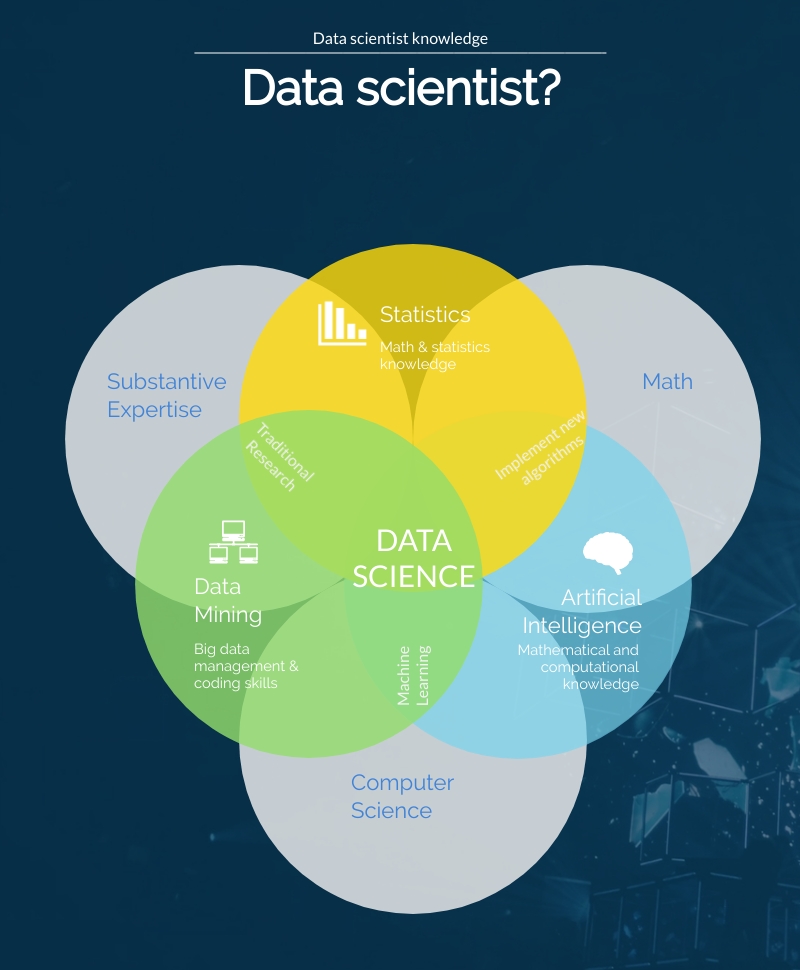
By 2016, global internet traffic reached the Zettabyte scale (1 ZB = 1021 bytes) — a figure considered purely theoretical just years earlier. The information on the network is both structured and unstructured (video, audio, images, text), and to analyse it, the "classic" Analyst is no longer sufficient. A new professional figure emerged: one combining mathematical and statistical training with software engineering skills, capable of working with massive, heterogeneous datasets. This is the Data Scientist.
Data Science is a discipline built on data integration, algorithm development, and technological infrastructure. It focuses on the analytical resolution of complex, real-world problems at scale.