Analyst and Data Scientist
Until the end of the 90s, the only professional figure that had the task of analyzing data and extracting useful information from it was the "Data Analyst".
With the advent of web 2.0, social networks and an exponential increase in the computational capabilities of computing tools, this profession has changed radically and split into two: Analyst and Data science.
Analyst
The internal data generated by companies or organizations are usually collected for the correct organizational and managerial functioning of the complicated business machine. To have an optimal use of these, Management Control was born, a business area in which data Analysis, technical and economic skills come into play.
This business body (included in business intelligence) has now become indispensable, especially in large companies, for planning and controlling business performance and for helping management to set objectives and achieve them in all business areas.
This profession tends to reason on data of limited size (compared to the Data Scientist), structured and/or sample-based, for market surveys, or derived from the characteristic management of a company, for business planning.
Data Scientist
Internet traffic in 2016 reached the size of the Zettabyte (1 zb = 1,000,000,000,000 gb), a size considered theoretical until a few years earlier and absurd considering that 20 years earlier we only reasoned in Kilobytes and Megabytes.
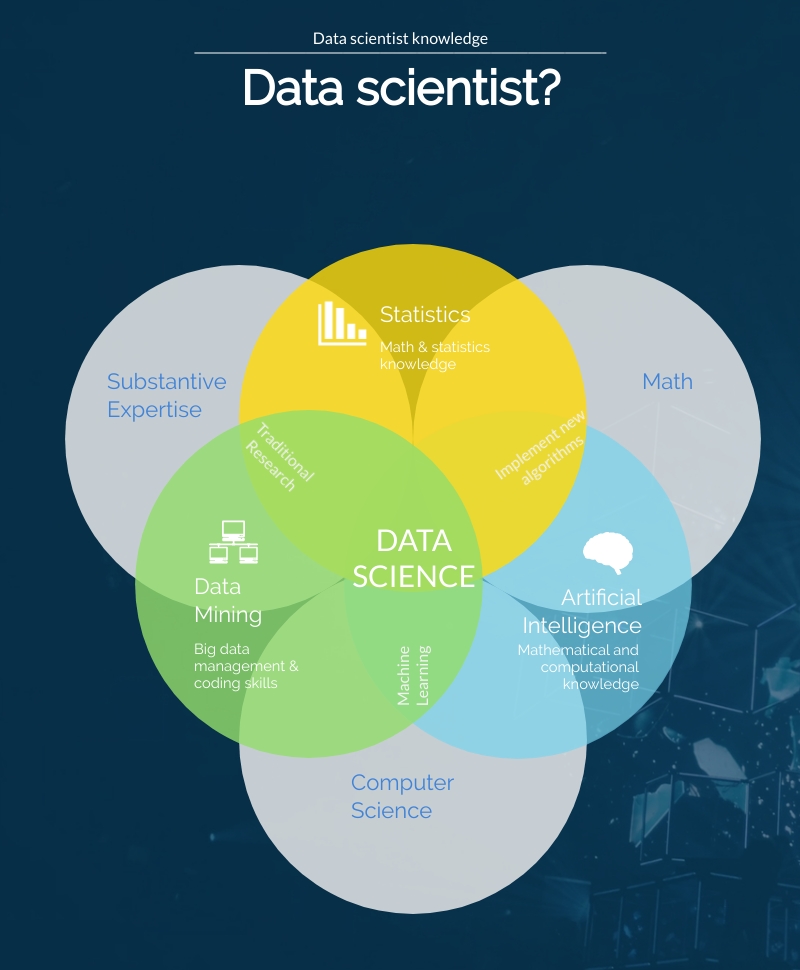
The information present on the network is both structured and unstructured (such as videos, audio, images ...) and to analyze this data, the "classic" Analyst is no longer enough and a professional figure was born that could combine mathematical/statistical training with IT skills to be able to reason with large sizes of data and different types: the Data Scientist.
Data science is a branch of knowledge that is based on knowledge related to data integration, algorithm development and technological capabilities: in fact it focuses on the analytical resolution of complex problems.